“This article is a contribution to the special issue of Aging celebrating the life and work of Misha Blagosklonny (more formally, Mikhail Vladimirovich Blagosklonny), who died in October 2024.”
In this review, David Gems and Alexander Carver from University College London, together with Yuan Zhao from Queen Mary University of London, present a new theoretical model to explain how aging leads to the development of chronic diseases. Drawing on evolutionary theory and biological research, the authors propose that aging is driven by a combination of early-life damage and harmful genetic activity in later life. This framework helps explain why diseases such as cancer, arthritis, and infections often appear in old age and offers insight into how they might be prevented.
Aging is the biggest risk factor for most chronic diseases, but the biological reasons for this association are still debated. The authors address this by introducing a two-stage model. In the first stage, individuals experience disruptions early in life, such as infections, injuries, or genetic mutations. Although the body can often contain or repair this damage, it does not fully eliminate it. In the second stage, which begins in later life, normal genetic processes begin to act in ways that are no longer beneficial. These late-life changes weaken the body’s ability to contain earlier damage, allowing it to develop into disease.
The review emphasizes that aging is a multifactorial process, shaped by many interacting causes rather than a single underlying mechanism. The model suggests that early-life disruptions and later-life genetic activity work together to drive age-related diseases. For example, dormant viruses can re-emerge as infections like shingles due to weakened immunity in older adults. Similarly, injuries to joints in youth can lead to osteoarthritis as tissues change with age. Inherited mutations may also remain silent for decades before contributing to conditions such as cancer or fibrosis later in life.
This two-stage model builds on long-standing ideas from evolutionary biology, particularly the theory that aging occurs because natural selection has less influence in later life. The authors also draw on studies in the roundworm Caenorhabditis elegans, where early mechanical damage can lead to fatal infections in old age, suggesting similar patterns may occur in humans.
Overall, this review presents a new framework for understanding how different causes of aging interact over time. By identifying two key stages, early-life damage and late-life genetic activity, it highlights potential strategies for promoting healthier aging through prevention and targeted intervention.
In a new study, researchers used C. elegans to investigate how changes in lipids during aging might impact lifespan and healthspan.
The Trending With Impact series highlights Aging publications (listed as “Aging (Albany NY)” by Medline/PubMed and “Aging-US” by Web of Science) that attract higher visibility among readers around the world online, in the news, and on social media—beyond normal readership levels. Look for future science news about the latest trending publications here, and at Aging-US.com.
—
Listen to an audio version of this article
Lipids are a diverse group of biomolecules that are essential for life, including fats, oils, waxes, and steroids, and play crucial roles in cell membrane structure, energy storage and signaling. Lipidomics is the comprehensive analysis of lipids and their interactions in biological systems, with an aim to understand the role of lipids in cellular processes and their association with diseases. As we age, our cells undergo complex changes, including alterations in cellular lipid profiles. These changes are not only confined to humans; organisms such as the nematode Caenorhabditis elegans (C. elegans) are also subject to changes in lipid composition during aging.
“For example, lipid classes including fatty acids (FA), triacylglycerols (TAG), sphingolipids (SL), and phospholipids (PL) have been identified as targets in lipid signatures related to aging [2, 3]. Furthermore, specific signatures are detected in the lipid profiles of those with age-related diseases, such as Alzheimer’s Disease [4–9]. In addition, the abundance of many fatty acid subtypes differs between the youth, elderly, and centenarians [10, 11].”
In this study, the researchers focused on two enzymes that are important in the production of ceramides—a type of lipid that is known to play a role in various cellular processes, including cell signaling and apoptosis. The enzymes, acid sphingomyelinase 3 (asm-3) and ceramide synthase (Hyl-2), are involved in the breakdown of sphingomyelin and the synthesis of ceramide, respectively. The team compared C. elegans with mutations in these specific genes with wild type C. elegans at one-, five- and 10-days of age to investigate how changes in these enzymes affect lipid profiles during aging.
“In particular, work using C. elegans have identified age related changes in specific lipids, lipid classes, as well as the ratio of monosaturated to polysaturated fatty acids (MUFA:PUFA ratio) [36, 37]. Here, we examine the lipidomes of animals lacking the sphingolipid metabolism enzymes, asm-3/acid sphingomyelinase or hyl-2/ceramide synthase, which have previously been shown to have extended and reduced lifespans, respectively, in C. elegans [24, 34, 38].”
The results showed that the asm-3 mutant worms had higher levels of sphingomyelin and lower levels of ceramides compared to wild-type worms. In contrast, the hyl-2 mutant worms had lower levels of sphingomyelin and higher levels of ceramides. These findings suggest that asm-3 and Hyl-2 have opposite effects on the production of ceramides in C. elegans. The researchers also found that the lipid profiles of the mutant worms changed with age, with a decrease in sphingomyelin and an increase in ceramides in the asm-3 mutant worms and, in the hyl-2 mutant worms, there was an increase in sphingomyelin and a decrease in ceramides with age.
The researchers also investigated the effects of these lipid profile changes on lifespan and healthspan. They found that the asm-3 mutant worms had a shorter lifespan and reduced healthspan compared to wild-type worms. In contrast, the hyl-2 mutant worms had an extended lifespan and improved healthspan. These findings suggest that changes in lipid profiles can have significant effects on lifespan and healthspan in C. elegans.
Conclusions
Overall, this study sheds light on the complex role of lipids in aging and highlights the importance of ceramides in cellular processes. The findings suggest that changes in the production of ceramides, mediated by asm-3 and Hyl-2, can have significant effects on lifespan and healthspan in C. elegans. Further research in this area could lead to the development of interventions that target ceramide production to promote healthy aging in humans.
There are several potential implications of this study for human health. First, the findings suggest that interventions aimed at modulating ceramide production could have significant effects on aging-related diseases. Ceramide has been implicated in various diseases, including cancer, Alzheimer’s disease and diabetes. Targeting ceramide production could be a promising strategy for the prevention and treatment of these diseases.
Second, the study highlights the importance of understanding the complex interplay between lipids and cellular processes in aging. Aging is a complex process that involves multiple cellular and molecular changes, and alterations in lipid metabolism are just one aspect of this process. A better understanding of the role of lipids in aging could lead to the development of new interventions that target multiple aspects of the aging process.
Finally, the study underscores the importance of using model organisms, such as C. elegans, to investigate the molecular mechanisms of aging. While C. elegans is a simple organism, it shares many fundamental biological processes with humans, and its short lifespan makes it an ideal model for aging research. The findings from this study could be applied to future research in humans, as well as other model organisms, and could lead to the development of novel interventions for aging-related diseases.
“Age caused increased sphingomyelin levels, particularly in short-lived animals. This may suggest that the regulation of sphingolipid metabolism may mediate changes in cell structure and function important for healthy aging. Future studies connecting lipidomic changes in sphingolipid metabolism mutants to mechanistic changes in cells of mutant models will be important next steps to better understanding the roles of sphingolipids in aging.”
Click here to read the full research paper published by Aging.
Aging is an open-access, peer-reviewed journal that has published high-impact research papers in all fields of aging research since 2009. These papers are available to readers (at no cost and free of subscription barriers) in bi-monthly issues at Aging-US.com.
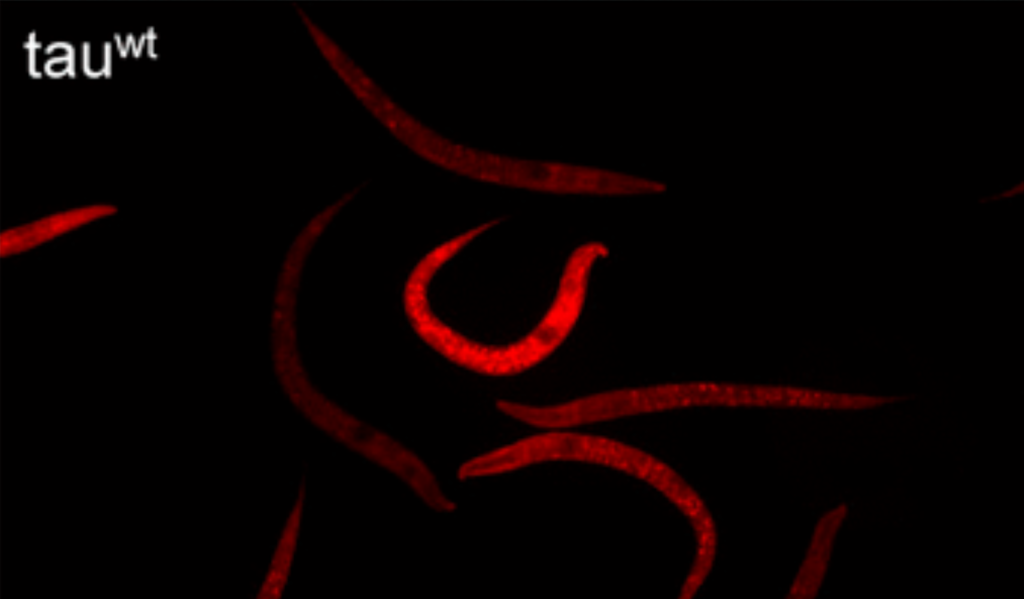
Researchers examined roundworms to determine the role of mitochondrial dysfunction in progressive neurodegenerative disorders, such as Alzheimer’s disease.
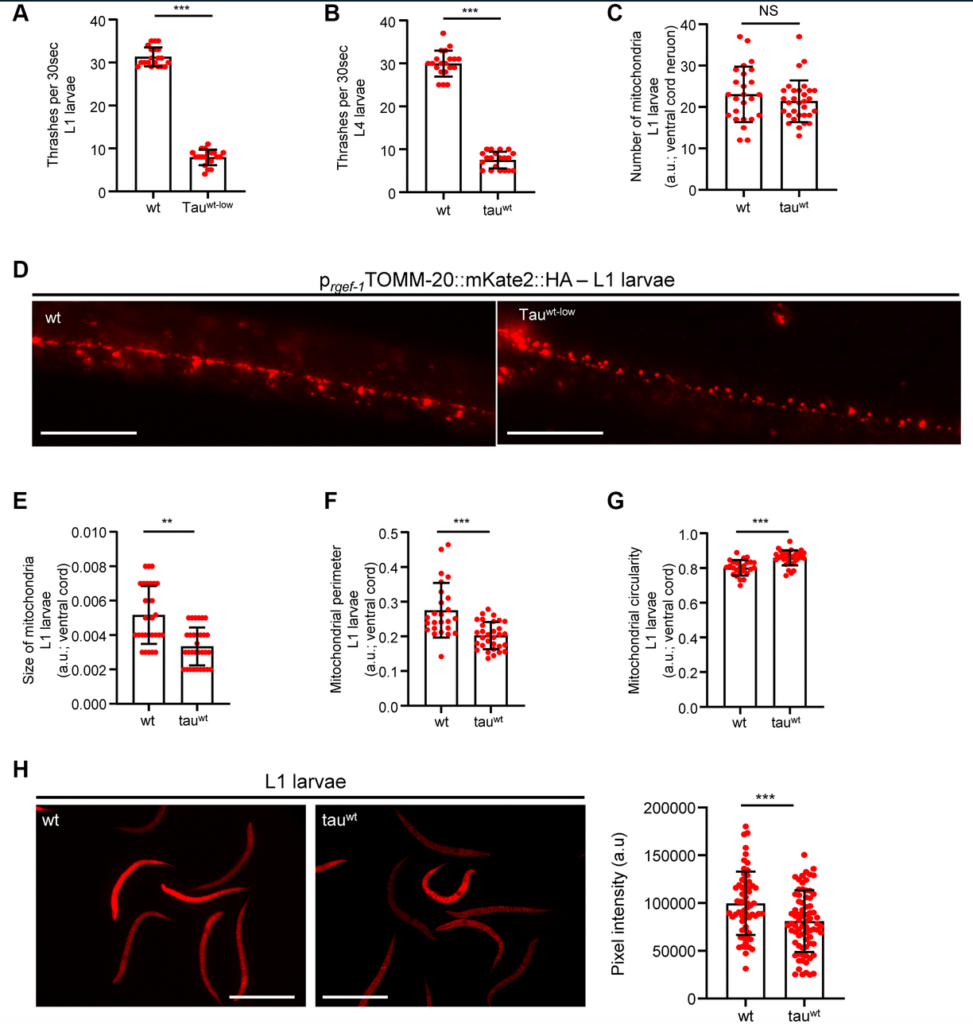
From Figure 2. Altered mitochondrial morphology and activity in tauwt-expressing larvae. (truncated)
The Trending With Impact series highlights Aging (Aging-US) publications that attract higher visibility among readers around the world online, in the news, and on social media—beyond normal readership levels. Look for future science news about the latest trending publications here, and at Aging-US.com.
—
Listen to an audio version of this article
Many aging-associated neurodegenerative disorders, including Alzheimer’s disease, involve the aggregation of abnormal tau in nerve cells (neurons). Normally, tau proteins function to stabilize microtubules in the brain. Tauopathy occurs when tau proteins become misfolded and misshapen (which turns tau into toxic tau). They then continue to proliferate and bind to each other, forming tau oligomers. These tau oligomers are more toxic and have a greater potential to spread tau pathology. Before the tau pathology snowballs into neurodegenerative disorders, the events that lead up to abnormal tau have remained elusive to researchers.
“While the association between tau levels and energy metabolism is established, it is not clear whether mitochondrial dysfunction is an early pathological feature of high levels of tau or a consequence of its excessive formation of protein aggregates.”
“Here, we utilized transgenic nematodes expressing the full length of wild type tau in neuronal cells and monitored mitochondrial morphology alterations over time.”
To investigate the impact of tau on mitochondrial activity, neuronal function and organismal physiology, the researchers selected and cultured an already characterized nematode strain that expresses the full length of wild type human tau protein. They compared wild type nematodes with tau-expressing nematodes (at various ages) over time using a thrashing assay, mitochondrial imaging, worm tracking software, and western blot analysis. Calcium deregulation was also examined to determine whether or not it is implicated in the impairment of mitochondrial activity in the tau-expressing nematodes. They found that chelating calcium led to restored mitochondrial activity and suggested a link between mitochondrial damage, calcium homeostasis and neuronal impairment in this nematode model.
Figure 2. Altered mitochondrial morphology and activity in tauwt-expressing larvae.
Conclusion
“Our findings suggest that defective mitochondrial function is an early pathogenic event of tauopathies, taking place before tau aggregation and undermining neuronal homeostasis and organismal fitness.”
The researchers were forthcoming about limitations in their study, given the differences between human and nematode biology and pathology. Nevertheless, they found evidence that, in this nematode tauopathy model, neurotoxicity depends on protein alterations and mitochondrial dysfunction. Mitochondrial dysfunction takes place before high levels of tau are detected. Tau mutations may also modulate calcium homeostasis by influencing the main cellular storage sites—the endoplasmic reticulum and mitochondria.
“Investigating the tight interplay between tau oligomers and energy metabolism will enlighten new avenues for therapeutic strategies to slow or halt the progression of dementia-related diseases such as AD [Alzheimer’s disease].”
Click here to read the full priority research paper published by Aging (Aging-US).
Aging (Aging-US) is an open-access journal that publishes research papers monthly in all fields of aging research and other topics. These papers are available to read at no cost to readers on Aging-us.com. Open-access journals offer information that has the potential to benefit our societies from the inside out and may be shared with friends, neighbors, colleagues, and other researchers, far and wide.
The mechanisms and pathways involved in the health and aging benefits conveyed by green tea were investigated in C. elegans.
The Trending With Impact series highlights Aging (Aging-US) publications that attract higher visibility among readers around the world online, in the news, and on social media—beyond normal readership levels. Look for future science news about the latest trending publications here, and at Aging-US.com.
—
Listen to an audio version of this article
Boiled or iced with water or milk, blended in smoothies, condensed into shots or even baked into pastries—humans are infatuated with green tea. Today, green tea is one of the most widely consumed beverages in the world. Molecules found in this plant, named catechins, are known to have numerous evidence-based health benefits, including weight loss and age delaying properties. However, the mechanism by which these effects take place have yet to be fully elucidated.
“The popularity of green tea makes it crucial to study its impact on health and aging.”
“We have designed the current study to investigate the impact and to unveil the target of the most abundant green tea catechins, epigallocatechin gallate (EGCG) and epicatechin gallate (ECG).”
The Study
In this study, the researchers focused on testing two of the most common green tea catechins, epigallocatechin gallate (EGCG) and epicatechin gallate (ECG), in isolated mitochondria from murine liver and C. elegans. C. elegans are approximately one millimeter long nematodes, or roundworms, and have been used in a variety of biomedical studies. The reason C. elegans were chosen for this study is likely due to the fact that many genes in C. elegans have functional counterparts in humans. (C. elegans also have the ability to “smell” cancer.)
Over the course of 24 hours or seven days, C. elegans and rodent mitochondria were treated with 2.5 μM of EGCG and/or ECG compounds. To analyze the green tea catechins’ effects on cellular metabolism, reactive oxygen species (ROS) homeostasis, stress resistance, physical exercise capacity, health- and lifespan, and on the underlying signaling pathways, the researchers conducted lifespan analyses, locomotion assay, paraquat stress resistance assay, basal oxygen consumption rate, ROS quantification, glucose oxidation assay, ATP quantification, activity assays for catalase and superoxide dismutase, fat content analysis, quantification of complex I activity in mitochondria, quantification of oxygen consumption rate in mitochondria, and statistical analyses.
“We conclude that applying the green tea catechins EGCG and ECG at a low dose extends the lifespan of C. elegans via inducing a mitohormetic response.”
They found that the catechins hindered mitochondrial respiration in C. elegans after 6–12 hours, the activity of complex I in isolated rodent mitochondria and temporarily increased ROS levels. Then, after 24 hours and through adaptive responses, catechins reduced fat content, enhanced ROS defense and, in the long term, improved healthspan in C. elegans.
Conclusion
Mechanisms and pathways observed to be involved in this process of C. elegans fitness and lifespan extension by green tea were further described in the paper. The researchers note that additional studies will be required to determine the best timing and dosage for administering catechins. They also acknowledge that the low bioavailability of green tea catechins may limit the lifespan extending effects of green tea in humans, despite the promising effects demonstrated in C. elegans.
“Despite the promising results obtained in animal experiments, the low bioavailability of EGCG [7] still raises the question of whether green tea catechins can reliably provoke beneficial effects in humans. Consequently, additional efforts might be needed to identify complex I inhibitors with increased bioavailability.”
Click here to read the full priority research paper published by Aging (Aging-US).
Aging (Aging-US) is an open-access journal that publishes research papers monthly in all fields of aging research and other topics. These papers are available to read at no cost to readers on Aging-us.com. Open-access journals offer information that has the potential to benefit our societies from the inside out and may be shared with friends, neighbors, colleagues, and other researchers, far and wide.